
The Missing Institution (III)
Part Three: The Guild Curriculum, and Inheriting a Civilisation

The last of three essays. The first two argued that age-grouped schooling manufactures fear rather than interest, that knowledge detached from work cannot produce judgement, and that the guild was once the institution able to hold the two together. This essay sets out what a modern guild for children and families would actually consist of, and follows where it leads.
The Guild Curriculum
Every enduring settlement, whether a medieval market town or a modern city, must somehow feed itself, maintain its buildings, move its goods, welcome strangers, transmit its stories, clothe its people, keep its accounts, celebrate its festivals and govern its common life. Technologies change and economies change and political constitutions change, yet these functions remain remarkably constant, because they are not features of a particular century but conditions of collective life as such. A curriculum built around them is therefore a curriculum that cannot go out of date. Where the modern school organises learning around disciplines — history here, science there, mathematics in its own hour — the Guild organises it around the perennial work by which a community keeps itself alive, and lets the disciplines reappear, as they always did, inside that work.
The distinction is more than administrative. To organise learning around subjects is to ask first what a child should know; to organise it around functions is to ask first what responsibilities a flourishing community must discharge, and then to let knowledge follow from the discharging of them. A child does not study nutrition and then, much later, perhaps, cook a meal; the child cooks for a feast that two hundred neighbours will attend, and the chemistry of fermentation, the arithmetic of scaling a recipe and the history of a local dish arrive in the course of the work, fastened to a purpose, and are remembered because they were used. The guilds are therefore neither historical re-enactment nor a pageant of crafts. They are educational archetypes, and their medieval names serve only to mark the antiquity of the functions they carry, while the work itself is wholly contemporary. Each governs a domain of civic life before it teaches any particular skill, and it is in this constitutional character, rather than in any individual activity, that the depth of the curriculum lies. The Keepers do not merely cook; they govern hospitality. The Porters do not merely carry; they govern circulation. The Gardeners govern the living systems of the place, the Joiners its made fabric, the Heralds its memory and symbols, the Players its public joy, the Merchant Adventurers its exchange and the Drapers its material culture. A child who passes through them does not collect a set of hobbies. The child is inducted, function by function, into the working constitution of a town.
The Two Foundations
Patrick Geddes, who spent his life thinking about how cities live and die, described every settlement as holding two kinds of work in balance. There are the anabolic functions, which nurture, cultivate, store and sustain, and the katabolic functions, which move, circulate, break down and carry away; a town flourishes when the two are in proportion and sickens when either fails. The Guild takes this division as the floor of its curriculum, and every child, whatever they later specialise in, passes first through both foundations, so that no one grows up understanding only how things are made and not how they move, or only how a crowd is marshalled and not how it is fed. To have kept a kitchen and run a get-in, to have both sustained and circulated, is to understand a town from both of its sides before choosing a direction within it.
The Guild of Keepers
The Keepers govern hospitality, which is the first civic act and the one most easily mistaken for a private virtue. Long before a community can debate or trade or build, it must be able to receive — the stranger at the gate, the neighbour in trouble, the guest at the table — and to sustain its own members through the ordinary attrition of days. A civilisation that cannot welcome is not yet a civilisation; it is a fortress. The Keepers learn welcome as a discipline rather than a mood, and in doing so acquire a particular cast of mind: the habit of anticipating what another person will need before they ask, the attentiveness that reads a room and notices the guest left standing, the unglamorous constancy of care that returns to the same tasks day after day because care is not an event but a practice.
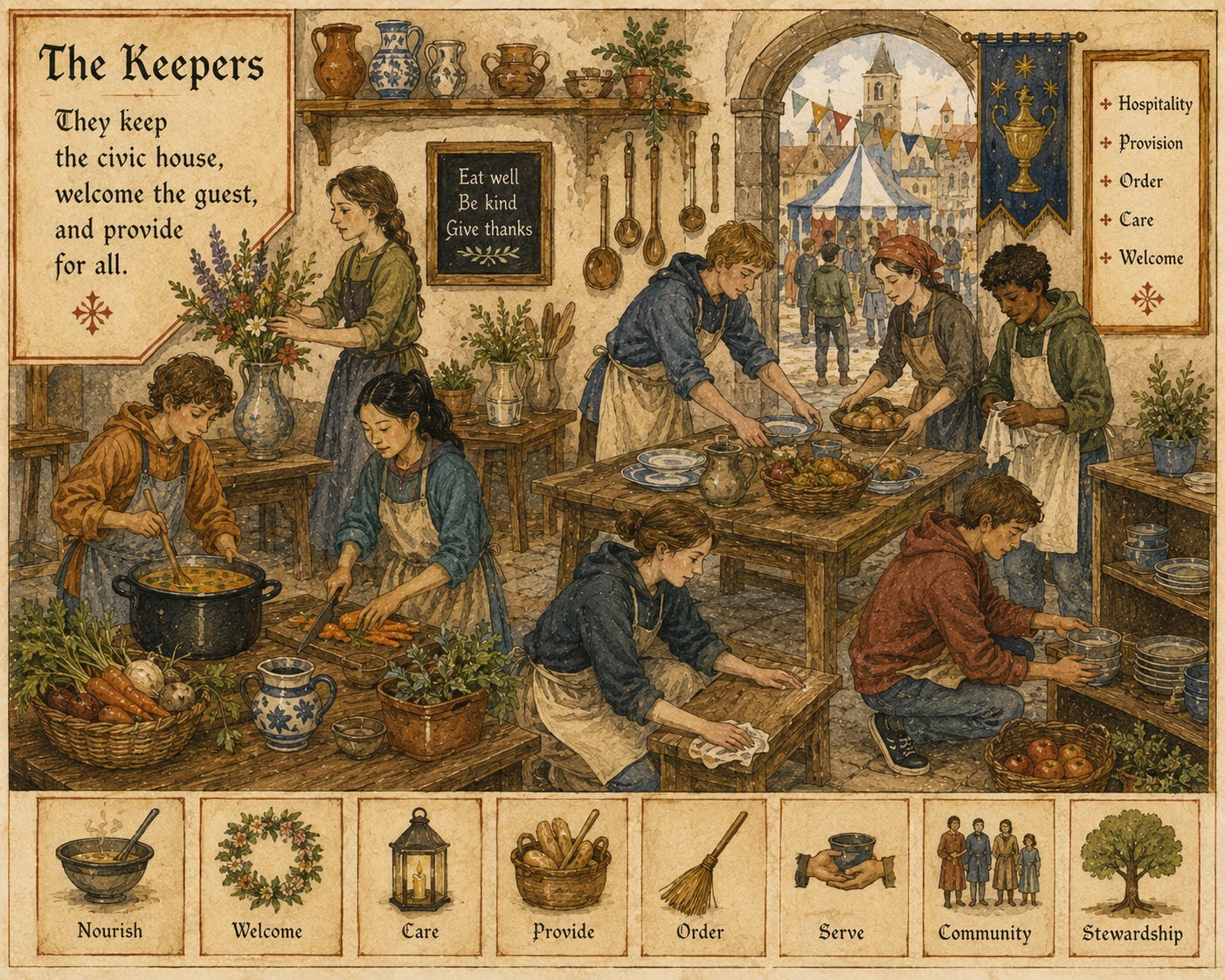
In practice the guild holds the threshold, the table and the common house. Its members cook, increasingly from the produce the Gardeners raise, learning to bake bread and to preserve the autumn glut against the winter feast, to brew cordials and ferment and pickle, to dress a table and lay a place and carry a course, to keep the inventories of linen and crockery, to maintain the hall and ready its rooms, and to manage the genuine logistics of feeding a crowd. A Midwinter dinner for two hundred is not produced on the day; it is the visible end of months of quiet work, of jams sealed in September and a menu costed in November and a kitchen rehearsed in the week before, and a child who has lived through that cycle has learned planning, proportion and responsibility more thoroughly than any exercise could teach. The chemistry of a rising loaf, the arithmetic of multiplying a recipe by fifty, the biology of what nourishes a body and the history of why a particular dish belongs to a particular place all enter through the kitchen door, unannounced and load-bearing. The household joins here most naturally of all: the grandmother’s recipe carried to the common table, the parent at the stove, the dish that is the family’s contribution to the feast. And the guild has its delights, the harvest loaf plaited into a wheatsheaf, the sugar subtlety built for the high table, the wassail bowl carried out at Midwinter, so that a child learns, in the deepest way available to a child, that to feed people well is one of the oldest forms of love a community has.
The Guild of Porters
The Porters govern circulation, the katabolic counterpart to the Keepers’ nurture, and theirs is the least visible and most indispensable work in any town. Nothing gathers without first being moved; no festival rises that was not first carried, raised and marshalled; the freedom of a crowd to enjoy itself rests entirely on an organisation it never sees. The Porters learn the ethic of readiness, the foresight that sequences a hundred tasks so that each is done before it is needed, the calm that holds when a plan meets the friction of a real morning, and the reliability on which everyone else’s work silently depends. It is an education in a humility that is also a kind of mastery, for the Porter discovers early that the most important person at an event is often the one no one notices.
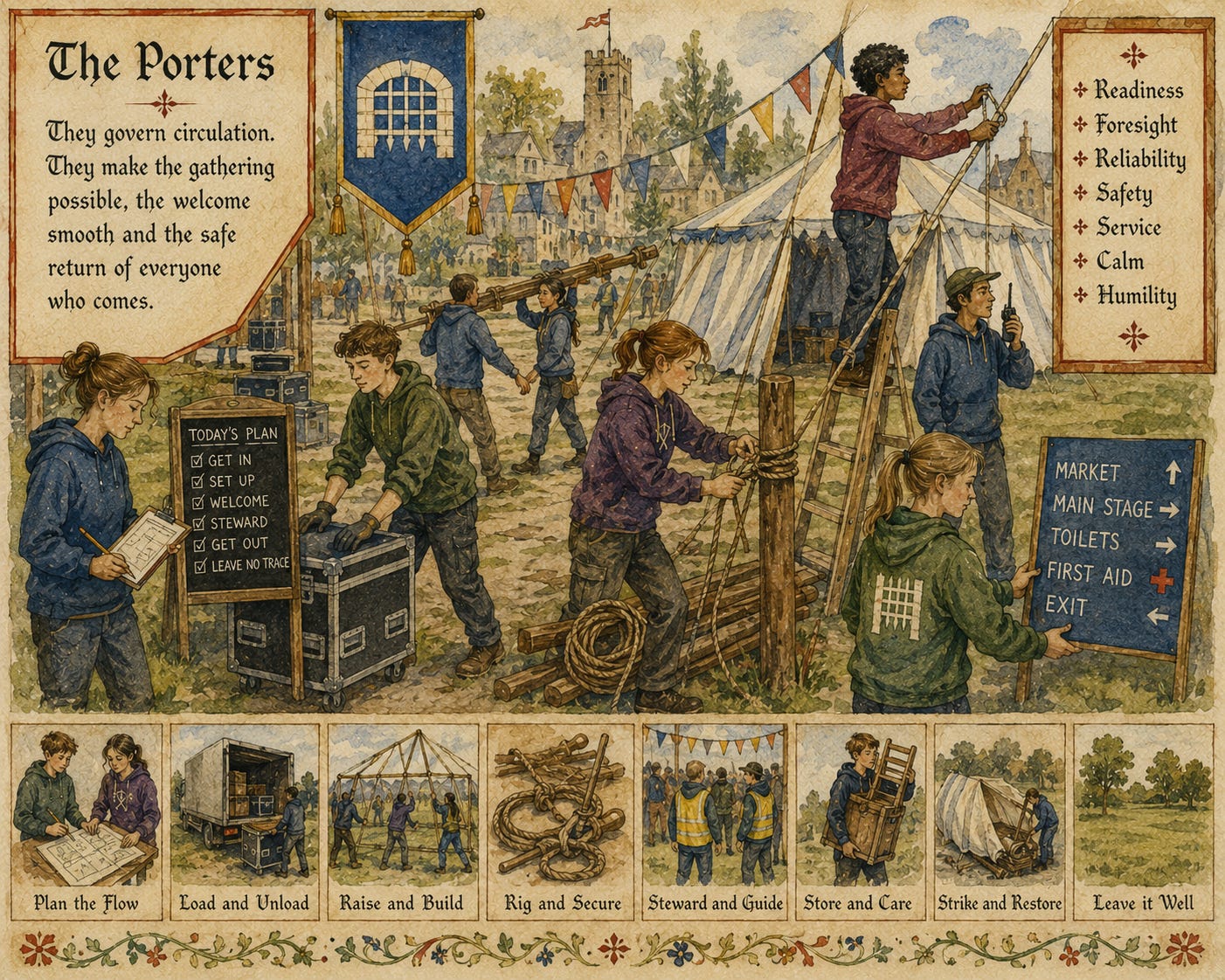
The guild’s work is logistics in the full old sense. Its members plan and execute the get-in and the get-out, raise marquees and staging and strike them again, store and inventory the equipment of every other guild, plan routes and steward crowds, rig and knot and lift, set out a market and clear a ground, and learn the discipline of safety as a form of care for others rather than a list of rules. They build the May Day field from an empty green in a morning and return it to grass by nightfall, and in the building of it they meet geometry as load and balance, physics as the behaviour of structures and forces, and the operational mathematics of moving people and things through space and time. The practically gifted adults of a town find their home here, the builders and drivers and riggers, the people who can fix and shift and improvise, and the teenager who has been told too often that he is not academic discovers that he can hold the logistics of a festival in his head and that others depend on his doing so. The delight of the guild is the cathedral of canvas going up where there was nothing, the satisfaction, rare in modern childhood, of having built the conditions of a celebration with one’s own hands and then watched the celebration fill them.
The Pathway Guilds
Beyond the two foundations lie the specialist guilds, which a child enters as interest declares itself, moving between them as curiosity leads, the wandering disciplined by responsibility rather than confined by age. Each governs a further domain of the town’s life, and each is deep enough to occupy a lifetime without exhausting it.
The Guild of Gardeners
The Gardeners govern ecological stewardship, the care of the living systems on which everything else depends, and theirs is the slowest education in the curriculum and in some ways the most important. A town that cannot keep its ground alive cannot keep itself alive, and the habits the garden teaches — patience with what cannot be hurried, the long view that plants in autumn for a harvest a year away, the close observation of weather and season and soil — are precisely the habits a culture addicted to immediacy has most thoroughly lost. To garden is to be apprenticed to time itself, and a child who has waited out a growing season has learned something that no accelerated process can supply.
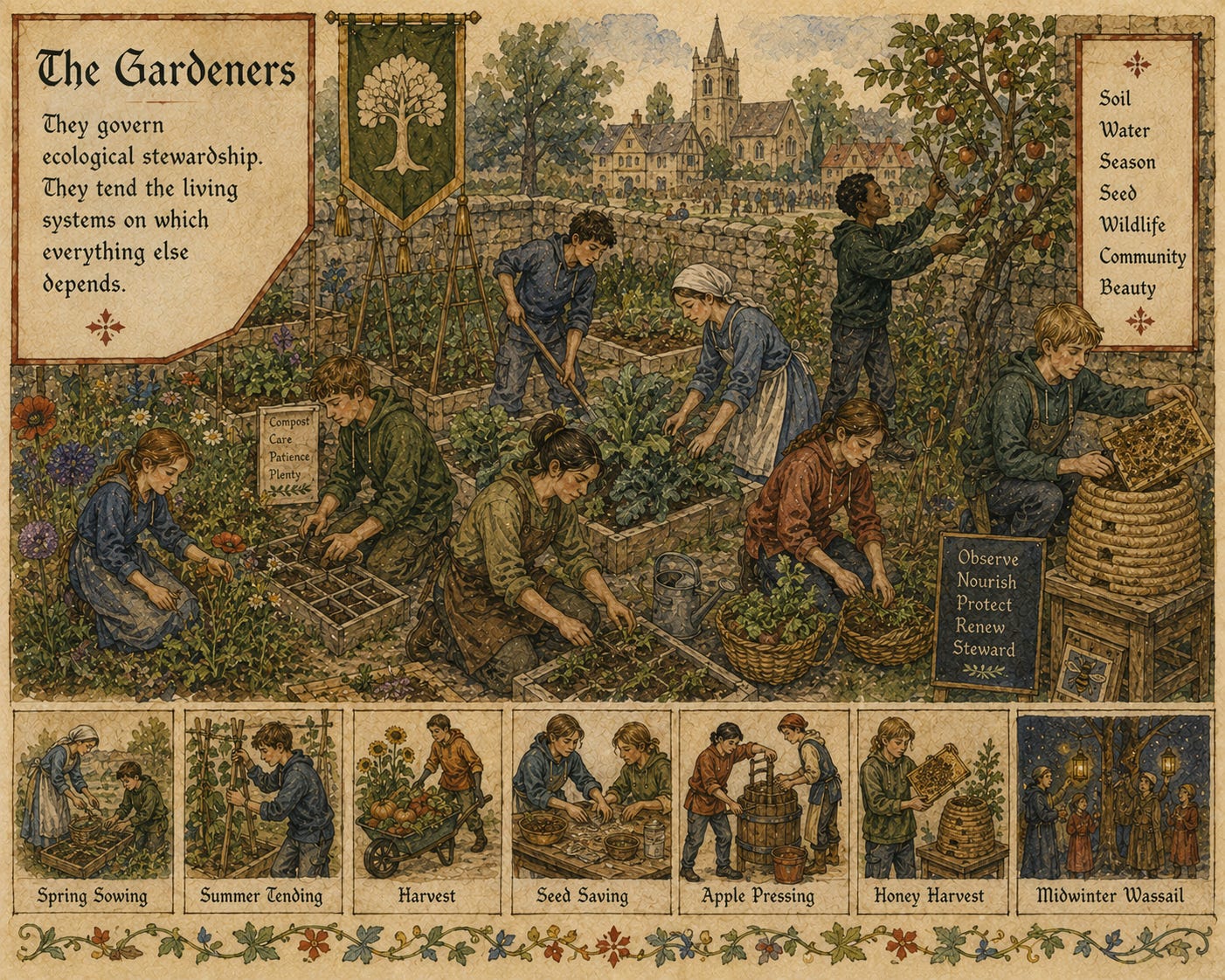
The guild cultivates the kitchen garden that supplies the Keepers, raising vegetables and herbs and orchards, making compost and saving seed, propagating and grafting, keeping bees and reading soil, laying hedges and sowing the wildflower meadow, and turning with the wheel of the year from the spring sowing through the Harvest to the Michaelmas apple-pressing and the Midwinter wassail of the orchard. Botany and ecology live here as daily practice rather than diagram, the chemistry of soil and compost is learned by hand, and the economics of yield and the history of a region’s heritage varieties — the local apple no supermarket stocks, the cultivar a particular valley made its own — arrive as part of the work of growing them. Grandparents who 1have gardened all their lives become teachers without lecturing, and the allotment knowledge that so often dies with a generation finds someone to receive it. The delights are seasonal and real: the first cider pressed from apples the children picked, honey drawn from the guild’s own hives, a meadow standing in flower that was bare soil in spring, the particular pride of eating at a feast the food one grew. The Gardeners learn, in their bones, that beauty and use are not opposites and that a place is kept alive only by those willing to tend it slowly.
The Guild of Joiners
The Joiners govern repair, the maintenance of the made fabric of the town, and they stand against the deepest assumption of a disposable age, which is that what breaks should be replaced rather than mended. Every civilisation inherits more than it builds, and it endures only so long as some body holds the skill and the inclination to keep that inheritance standing; when the people who can repair a thing disappear, the thing is declared beyond saving, and a culture begins to throw away its own past. The Joiners learn the diagnostic eye that asks what is wrong and why before it reaches for a tool, the precision and patience that good making demands, and the respect for material that distinguishes repair from mere replacement. Theirs is the ethic of mending, which is among the most civilising dispositions a child can acquire.
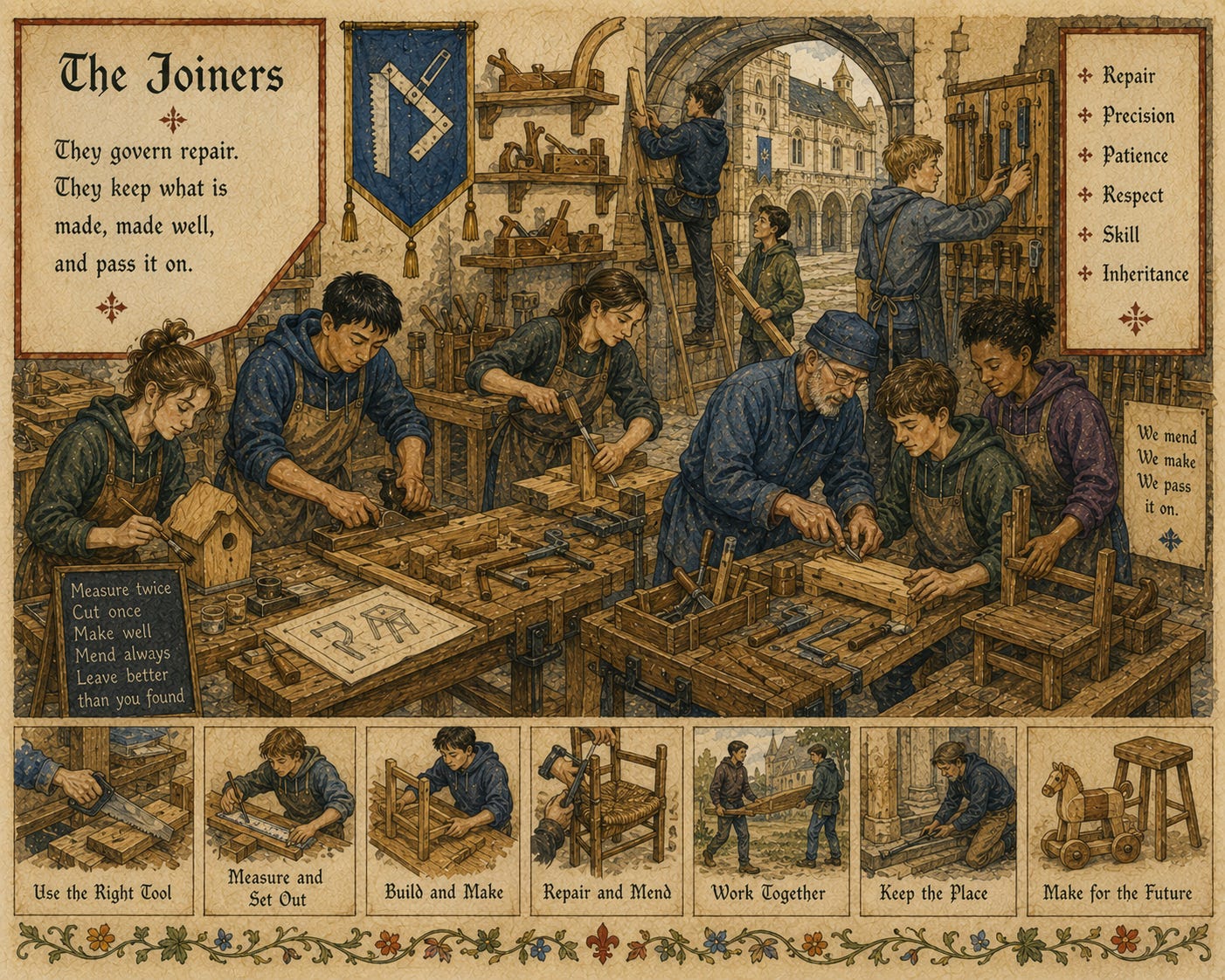
Their work runs from the workbench to the building itself. Members learn woodwork and joinery, the maintenance and sharpening of tools, measurement and setting-out, the building of the trestles and benches and staging the festivals require, and the making of things meant to last — a bird box, a wooden toy, a stool that will outlive its maker. As they advance they take on real conservation tasks on the building that houses the Guild, so that the curriculum and the fabric of the institution repair one another, and the restoration of the arcade’s own threshold becomes the first live project on which the young learn that a building is an inheritance and not a consumable. Geometry and the physics of forces, the mathematics of accurate measurement, the science of timber and stone and the history of how a place was constructed all enter through the act of keeping it standing. The retired craftsmen of a town, whose knowledge the formal economy has no further use for, find here both apprentices and dignity, and the man or woman who can fix anything becomes a recognised master. The delight of the guild is the oldest in making: the chair returned to use, the toy that works, the joint that holds, the visible, lasting evidence that one’s own hands have added something durable to the world.
The Guild of Heralds
The Heralds govern the symbolic life of the town, which is to say its memory, its ceremony and its sense of itself, and theirs is the guild that most clearly exceeds the crafts it employs. To describe the Heralds as doing calligraphy is to mistake the tool for the office. They are responsible for how a community remembers, how it represents itself to itself, and how its identity is carried in symbol from one generation to the next, and a town that loses this function does not merely lose some decoration; it loses the means by which it knows who it is. The habits the guild develops are those of the historian and the designer at once: the patient interpretation of inherited meaning, the eye that reads a building or a coat of arms as a text, the care for accuracy that memory demands, and the imaginative power to give a community legible form.
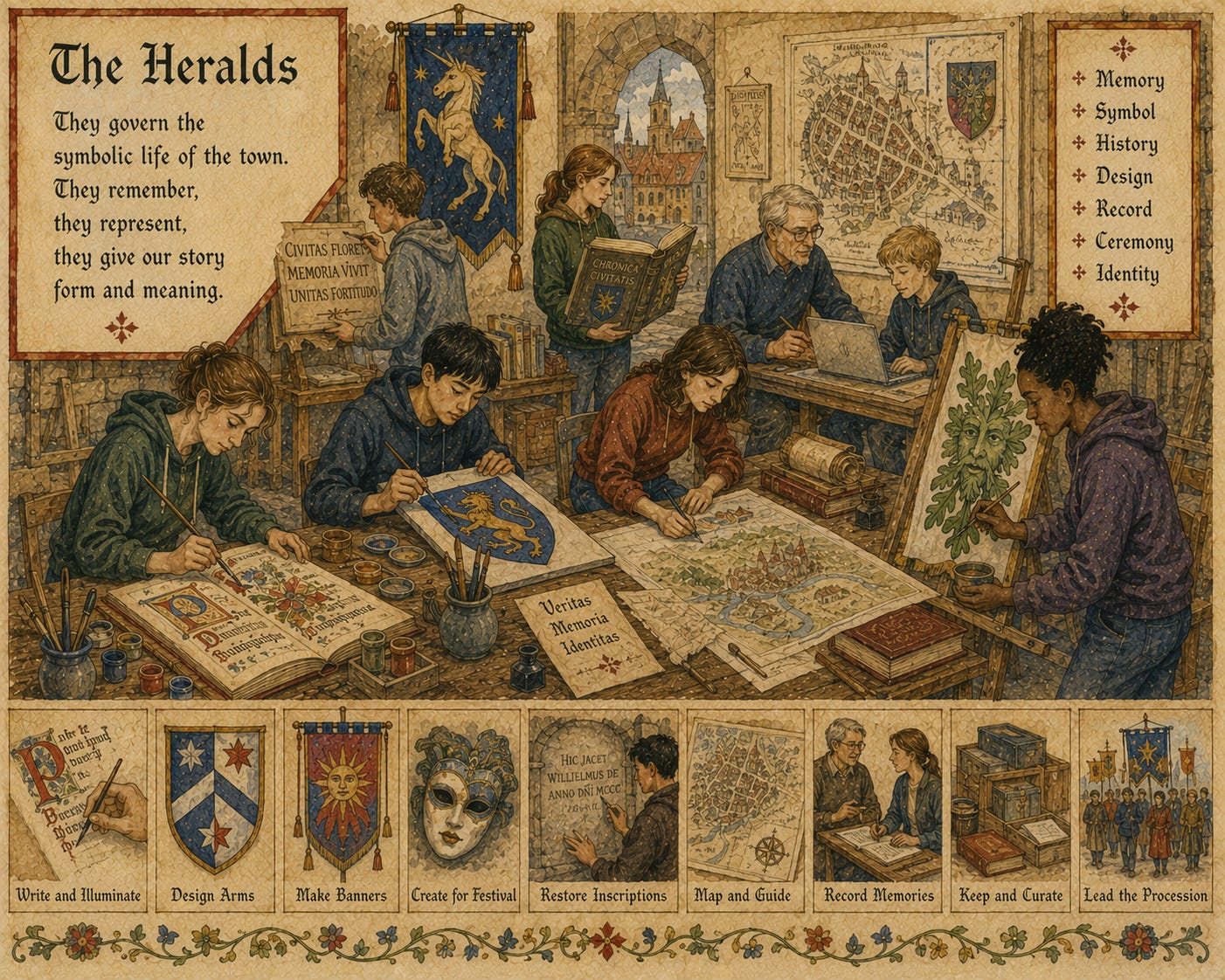
The practical range is enormous and the reason the guild can sustain years of learning. Its members design coats of arms and devise the iconography of the festivals, write illuminated charters and restore the memorial inscriptions time has worn away, draw civic maps and design the wayfinding that guides a stranger through the town, study the local architecture and produce the guidebooks that interpret it, interview the oldest residents and turn their recollections into a living archive, curate exhibitions, keep genealogies, and make the banners and the masks the processions require. Here history is not a subject but a daily encounter, art and design are practised for public use rather than private expression, writing acquires the weight of the charter and the inscription, and the reading of Latin or of an old hand becomes the key to a real document rather than an exercise. The local historians and artists of a town find their apprentices here, and the elderly resident whose memory would otherwise be lost finds someone to write it down. The delights are among the chapter’s brightest: the illuminated manuscript made by hand, the Venetian mask and the festival banner, the green man’s foliate face, a coat of arms a child has devised and may carry for life. The Heralds teach that a place which cannot remember itself cannot govern itself, and that memory, to survive, must be made.
The Guild of Players
The Players govern celebration, the public joy and collective enactment through which a community becomes briefly visible to itself, and theirs is the guild that turns a population into a people. Every civilisation must be able to gather and rejoice, to mourn and remember, to perform its own stories back to itself, and the festival, the procession and the play are not ornaments upon civic life but among its load-bearing structures, the occasions on which a scattered set of households discovers that it is a community after all. The Players learn the courage it takes to stand before others, the timing and ensemble that performance demands, the long discipline of rehearsal that precedes a single public moment, and the particular generosity of the performer who exists, in the act, for the sake of the watching crowd.
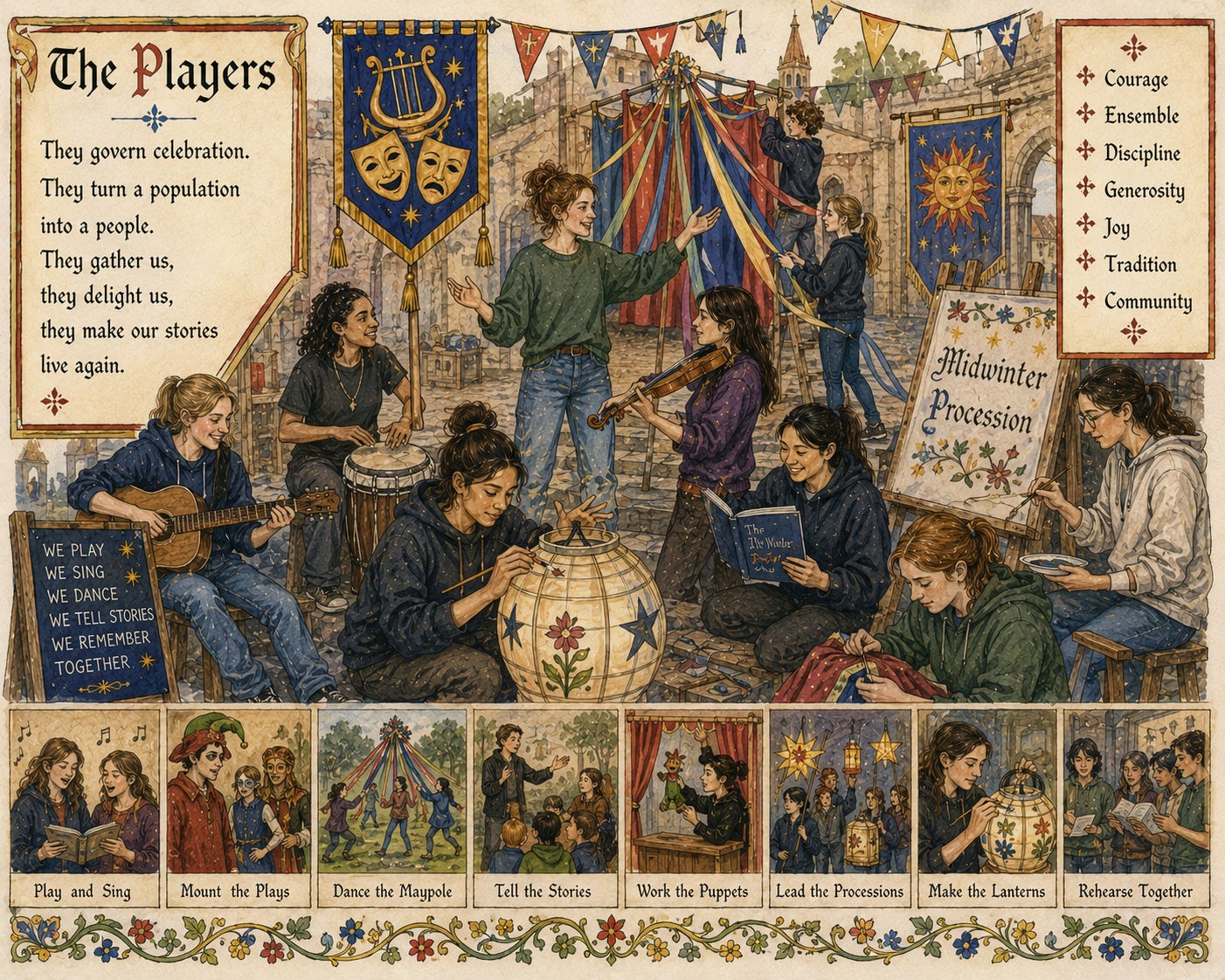
The guild carries the town’s music, theatre, dance, storytelling and procession. Its members play and sing, mount the mummers’ plays and the seasonal dramas, dance the Maypole and the old figures, tell the local stories and work the puppets, speak in public and lead the processions, and build the great instruments of festival spectacle — the lanterns that carry the Midwinter procession through the dark, the towering processional giants that need many hands to walk. Music and literature live here as practice, the history of folk drama and seasonal custom arrives through performing it, and the child who has spoken or sung or danced before the assembled town has acquired a confidence that no classroom confers. Whole families process together, the musicians of a town find their players, and the festivals become the public culmination toward which months of rehearsal have quietly built. The delights are the most exuberant in the curriculum: the lantern procession, the giant walked through the streets, the mummers’ play with its deaths and resurrections, the Maypole’s plaited ribbons, the sheer joy of having made a celebration that the whole town came out to share. The Players teach that joy is a civic achievement and that a community sustains itself partly by the quality of its festivities.
The Guild of Merchant Adventurers
The Merchant Adventurers govern exchange, the economic life of the town and its dealings with the wider world, and theirs is the guild that teaches that commerce, rightly practised, is a form of cooperation founded on trust. Every community must exchange, within itself and beyond its bounds, and the market is among the oldest civic institutions there is, the place where a town meets itself and the stranger meets the town. The guild develops a particular set of virtues that the modern economy too often severs from trade: numeracy that is also judgement, the trustworthiness on which any market finally rests, the capacity to weigh value and negotiate fairly, and the understanding that a price honoured and a bargain kept are civic acts.
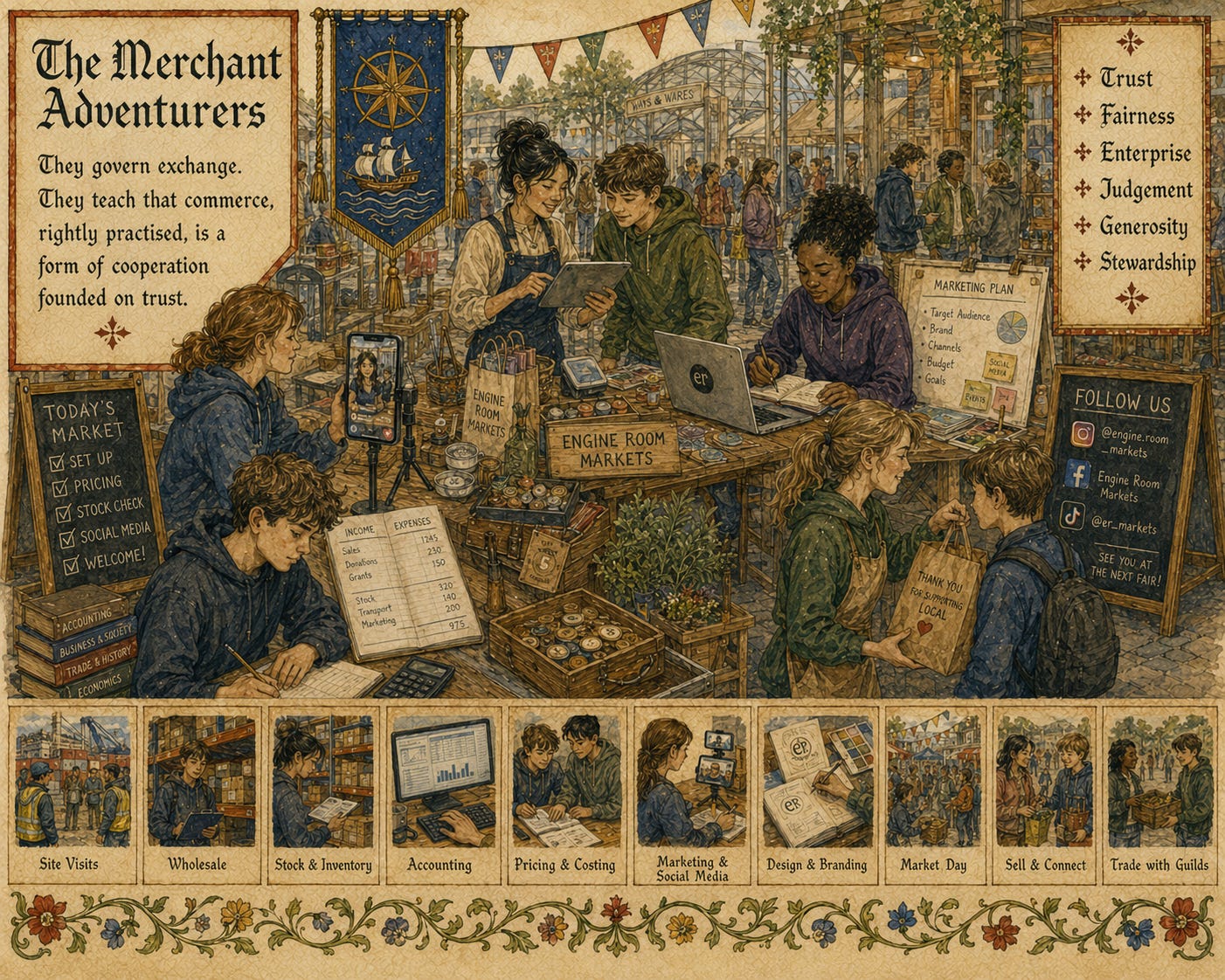
In practice the guild runs the markets the festivals require, keeps the accounts of the whole Guild, mints and manages a currency of merchant tokens through which the children’s economy actually runs, prices and stocks and keeps its stalls, trades with the other guilds for what they make and grow, and ventures into genuine enterprise by designing and selling the products of the Guild’s own work. The maritime history of a port town — and Southport’s whole existence is owed to the sea and the railway that brought the visitor to it — enters through the study of trade and navigation, economic history becomes the history of one’s own place, and mathematics arrives as the indispensable tool of the account book and the stall. The members of a town with business knowledge find their apprentices here, and a child learns, by handling a real market, the difference between price and value and the way trust underwrites every transaction. The delight is in the doing: minting one’s own coin, keeping a stall through a market day, watching a thing one made find a buyer. The Merchant Adventurers form the bridge between the children’s curriculum and the working economy of the Engine Room itself, so that the guild that governs exchange among children grows, in time, into a genuine apprenticeship in sustaining an institution.
The Guild of Drapers
The Drapers govern material culture, the textile and made textures of civic life, the clothing of its people and the adornment of its occasions, and theirs is among the most patient and beautiful of the crafts. Every civilisation must clothe itself and dress its ceremonies, and the textile arts carry a history of human ingenuity as deep as any, while the region’s own past — the cotton and the cloth on which the whole of the North West was built — makes the guild a direct inheritor of a local industry now largely vanished. The Drapers learn the fine discipline of slow handwork, the design sense that composes colour and pattern, and the satisfaction, increasingly rare, of making something to wear or to display that was begun from raw material.
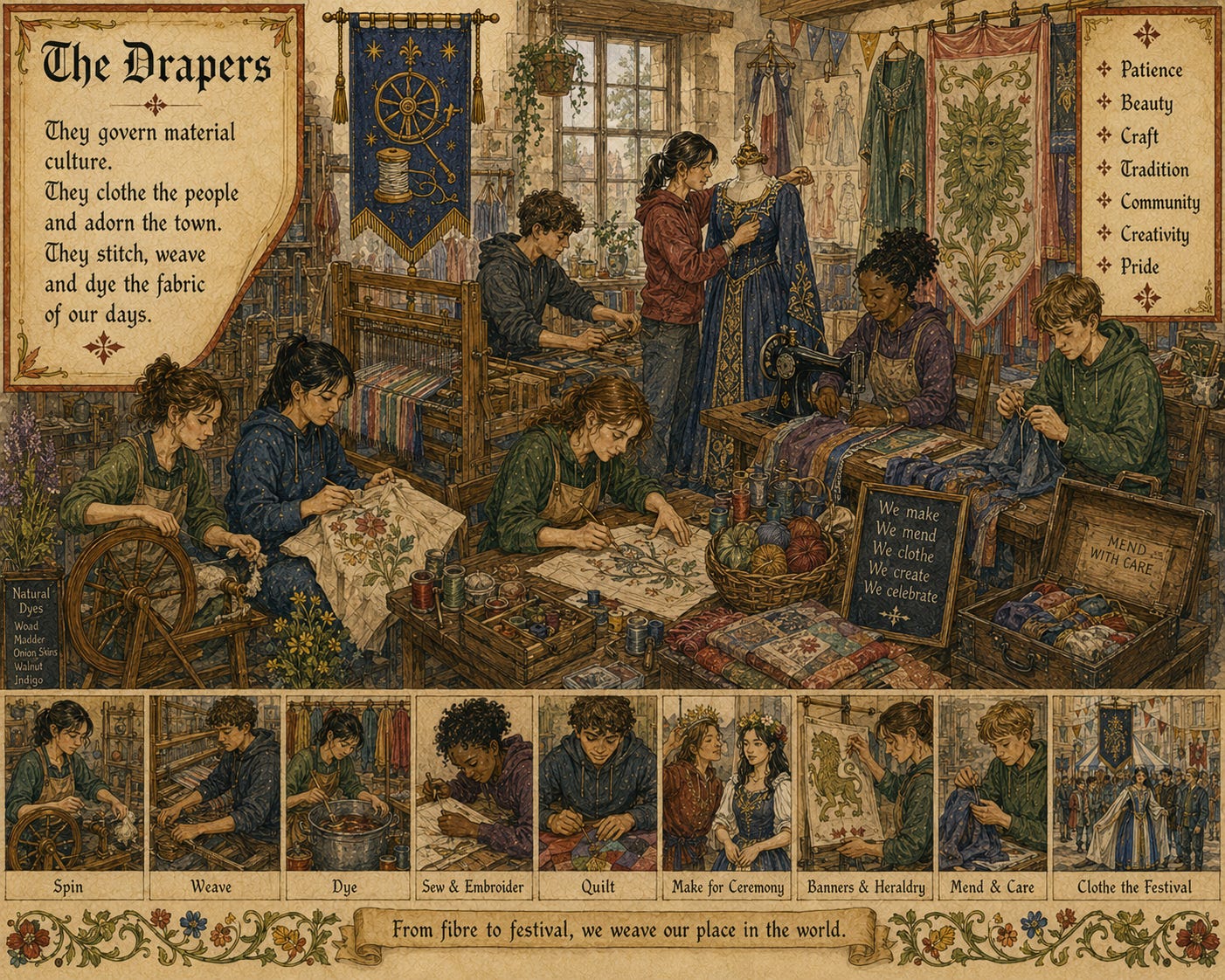
The guild spins and weaves and dyes, often with natural dyes drawn from the Gardeners’ own plants, and sews and embroiders and quilts, makes the costumes the Players wear and the banners the Heralds design, produces tapestry and regalia, and practises the mending of textiles that a disposable culture has forgotten. The May Queen’s crown and robe, the guild banners, the masks and costumes of the procession all originate here, so that the Drapers clothe the festivals the whole Guild builds. Geometry and pattern, the chemistry of the dye-vat, the history of the textile trade and the art of design all enter through the needle and the loom, and the grandmother whose needlework would otherwise be the last of its line finds a child to teach. The delights are vivid and tactile: dyeing wool with woad and madder, weaving a first length of cloth, stitching a costume one will wear in the procession, crowning the May Queen in regalia the guild has made. The Drapers teach that the texture of a civilisation — what it wears, what it hangs from its walls, how it dresses its great days — is itself a form of meaning, and that to clothe a community well is to honour it.
The Architects Guild
Eight guilds govern eight domains of civic life, and a town that possessed only these would still lack something, for hospitality, circulation, ecology, repair, memory, celebration, exchange and material culture do not assemble themselves into a festival or a functioning institution merely by existing side by side. Someone must see how they fit. Someone must know that the Joiners’ staging must stand before the Players rehearse upon it, that the Merchant Adventurers’ market depends on the Porters’ ground and the Drapers’ stalls, that a budget drawn without consulting the Gardeners’ planting calendar will fail in May whatever it promises in January. This is the office of the ninth guild, the Architects, who govern integration: the seeing of the whole and the holding together of its parts. No civilisation has ever been only a collection of excellent trades. It has always needed those who could think across trades, and a curriculum that produced eight kinds of excellent specialist and no one capable of coordinating them would have built a town with no one able to run it.
The Architects are therefore not a guild a child joins from the outset, in the manner of a Keeper or a Gardener, but one a member grows into, because its work presupposes a working knowledge of what every other guild requires. Its members learn to draft the master plan of a festival, sequencing the contributions of all eight guilds into a single working day; to build and hold a budget that spans the whole institution rather than a single trade; to mentor across guilds rather than within one, advising a Herald on logistics or a Porter on the calendar a feast demands; and to sit, eventually, on whatever body governs the Engine Room itself, carrying into adult stewardship the same habit of seeing the whole that the guild first cultivated in the planning of a Harvest fair. The habit of mind the Architects develop is integrative judgement, the capacity to hold eight legitimate claims on time, space and money in the head at once and to resolve them into a single working plan without favouring the trade one happens to love best. It is the rarest capacity the curriculum produces, because it cannot be taught directly; it can only be earned by long apprenticeship in several trades and the gradual extension of trust that follows.
The link to architecture in the literal sense is not accidental. The Architects study the building that houses the Guild as a whole — its plan, its structure, its history, the relation between its rooms and the lives that fill them — and in time take a hand in decisions about how the Engine Room itself should grow, which makes them custodians of the institution’s own fabric as well as its calendar. Economics enters through the budget that must balance across eight competing needs, history through the precedent of how past festivals succeeded or failed, and a civic education in the fullest sense through the plain fact of being trusted with the whole. The family joins here at its most consequential: a parent who has helped in the kitchen and on the logistics crew for a decade often finds, almost without noticing the transition, that they have become the person others ask when a festival needs a single point of decision, and the Guild simply recognises in title what has long been true in practice. The delight of the Architects is different from the delight of the other guilds, quieter and longer in the making — the satisfaction of watching a festival run as planned because every part had been considered, of seeing a building still standing and still used because its custodians took the trouble to understand it, of recognising, on a Midwinter evening with the hall full and warm, that one had a hand in the whole of it rather than a single part. The Architects teach what no other guild can teach alone, that a civilisation is not only made by hands but held together by judgement, and that someone must learn to carry the second if the first is not to go to waste.
The Annual Rhythm
A curriculum organised around civic functions needs a calendar organised around civic occasions, and the Guild’s year turns on four festivals — May Day, Harvest, Michaelmas and Midwinter — which are not breaks from the curriculum but the curriculum made public and put at risk. The festivals matter educationally precisely because they cannot be faked. A play unrehearsed will falter before the town; a feast unprepared will not feed the crowd; a market unstocked will stand empty; and so the festival exerts, on every guild at once, the steady pressure of a real deadline with real witnesses, which is the most powerful teacher of responsibility there is.
What the visitor sees on the day is the visible end of months of converging work. Through the late winter the Gardeners are sowing what the Harvest will reap and the Drapers are dyeing the wool that will become the May Queen’s robe; through the spring the Players are rehearsing and the Heralds are painting banners and the Joiners are building the staging the Porters will raise; through the summer the Keepers are preserving the glut that the Midwinter table will need. Each festival gathers the whole institution into a single occasion to which every guild contributes something without which the day would fail — the Gardeners’ flowers and harvest, the Joiners’ structures, the Heralds’ banners and the Players’ pageant, the Keepers’ feast and the Porters’ ground, the Merchant Adventurers’ market and the Drapers’ regalia, the whole sequenced and held together by the Architects’ plan — so that the festival becomes a working demonstration that a community still possesses the capacity to organise itself. The examination of the Guild is therefore not a paper sat in silence but a town assembled in the open, and a child is assessed in the only way that finally matters, by whether the work held up when other people were depending on it. Between the great occasions lie the quieter weeks in which the real learning is done, and a child comes to understand that a festival is the public culmination of hundreds of small and unglamorous acts, which is itself among the most valuable lessons the year can teach.
The Philosophy of Progression
A child moves through the Guild not by the calendar but by the slow accumulation of trust, and the old language of the trade marks the stages: Novice, Apprentice, Journeymaker and Master within whichever guild a member has chosen, and at the last, for a few, admission to the ninth guild of the Architects. The progression is a philosophy before it is a structure, and its governing principle is that responsibility is the true measure of learning and is conferred only when it has been shown to be safe to confer. The Novice watches and assists and learns the shape of the work; the Apprentice takes on a defined task and is answerable for it; the Journeymaker carries a whole piece of work and begins to guide those below; and the Master oversees a domain of the guild’s life and answers for its standards. Mastery within a single guild is not the end of the path but its precondition, for it is only those who have answered for a kitchen, a market or a workshop that the Guild will trust to answer for the whole, and admission to the Architects therefore marks the point at which a member’s competence has become broad enough, and their judgement trusted enough, to take responsibility for the institution itself. No one is advanced for having reached a birthday, and no one is held back for not having reached one, so that the gifted nine-year-old and the late-blooming fifteen-year-old each move at the speed of their own growing competence.
Badges and tokens mark the stages, but they record competence honestly demonstrated rather than attendance dutifully logged, and they are earned in public, witnessed by peers and elders, so that recognition is a communal act rather than a private certificate. Trust is built incrementally and visibly: the child who has reliably carried plates is given a dish to prepare, and the child who has prepared a dish well is given a course to run, and at each step the widening of responsibility is both the reward for competence and the occasion of the next learning. Mentoring is woven through the whole, for the surest evidence that a person has mastered something is that they can bring another to it, and so the Journeymaker teaches the Apprentice and the Apprentice steadies the Novice, and teaching becomes the proof of mastery rather than a separate role assigned from above. Leadership, in such a system, is not appointed but recognised, emerging in the one who notices what needs doing before being asked and whom others have come to trust, so that authority in the Guild is the visible residue of a history of responsibility honoured rather than a position conferred by an administrator. A child who entered at seven and has risen, year by year, to govern a festival has learned to lead in the only way that produces leaders worth following.
The Family as the Educational Unit
The Guild takes the household rather than the isolated child as the unit of its work, and this is the feature that most sharply distinguishes it from every other provision a modern child encounters. The conventional pattern is one of separation, in which the parent delivers the child to the professionals and returns to collect the product; the Guild reverses it, drawing the generations back into a single community of practice in which each has a real part to play. Grandparents become the keepers of story and of the old skills, the gardeners and needlewomen and craftsmen whose knowledge would otherwise die with them; parents become helpers and makers alongside their children rather than spectators of them; older siblings and teenagers, whom the age-graded system severs most completely from the young, become mentors and find in that charge a standing the wider world rarely offers them. Around the household gather the others a town contains and ordinarily wastes — the retired craftsman, the local historian, the artist, the builder, the volunteer with time and skill and no obvious place to give them — each of whom finds, in the guild that matches their gift, both apprentices and purpose.
This matters constitutionally and not merely sentimentally. An institution that depends on professional provision must be paid for and staffed and can vanish when the funding does; an institution that reproduces itself through the participation of families is rooted in something more durable, because the people it forms become the people who sustain it. The household that learns together how to feed a feast, build a festival, keep a garden or mend a building relearns how to act as a single civic body, and the capacity for collective action that a thinned-out town has lost is rebuilt first at the scale of the family and then at the scale of the guild and at last at the scale of the town. The child is formed, but so is the household, and the institution is formed through both. It is the difference between a service delivered to a community and a community learning to sustain itself, and only the second can answer the diagnosis with which this argument began.
It will be evident by now that every subject the school teaches reappears inside the Guild, though never as a subject. The Keepers and Gardeners do chemistry and biology; the Joiners and Porters do geometry and physics; the Merchant Adventurers do mathematics and economics; the Heralds do history and writing and art; the Players do music and literature; the Drapers do design and the chemistry of colour; and all of them, continually, do the practical mathematics of measure and quantity and the close observation on which every science rests. The difference is not in the knowledge but in its relation to the world, for in the Guild knowledge is always fastened to a use and a responsibility, and a child learns the arithmetic of a recipe because a feast depends on it and the history of a place because a guidebook must be written and the physics of a structure because a crowd will stand beneath it. The inert idea has no purchase here, because there is no idea that is not immediately wanted. What the Guild offers is therefore not less than a school offers but more, the same knowledge returned to the soil of practice in which it first grew and from which the modern curriculum uprooted it.
This is the claim the chapter has been building toward, and it can now be stated plainly. The Guild curriculum is rich enough, deep enough and various enough to occupy a child from the age of seven to the threshold of adulthood and beyond, not as an unusually thoughtful holiday programme but as the defining educational experience of a childhood, a formation in the working constitution of a town conducted alongside one’s family and neighbours through work that genuinely matters. It is, in the most exact sense, a constitutional proposal: an attempt to rebuild, between the household and the municipality, the intermediary institution through which a civilisation has always inducted its children into the responsibilities they will one day inherit. The festivals, the guilds, the slow climb from Novice to Architect, the grandmother teaching a stitch and the teenager steadying a younger child, the market and the garden and the mended door — these are not the furniture of a charming pastime. They are the means by which a place might once again raise the kind of people who can receive it, care for it and pass it on.
*A note on “civilisation”
I use the word civilisation deliberately, but not uncritically. As a scholar formed in part by Norbert Elias, I know how dangerous the term can be: how easily it becomes a language of hierarchy, refinement, exclusion and moral superiority; how often it has been used to distinguish the supposedly cultivated from the supposedly backward; how much violence has been concealed beneath its smoother meanings. Nothing in this argument depends on treating “civilisation” as an innocent word.
But it would be equally naive to imagine that we are not living in a civilisation now. We inhabit inherited systems of food, shelter, law, memory, transport, ceremony, care, exchange, education and repair, whether or not we choose to name them as such. The question is not whether civilisation exists, but whether we are forming children capable of understanding, criticising, sustaining and transforming the one they have received. In that sense, the word is not used here as a boast. It is used as a burden.