
The Missing Institution (II)
Part Two: Guilds, and the Institution We Need to Build

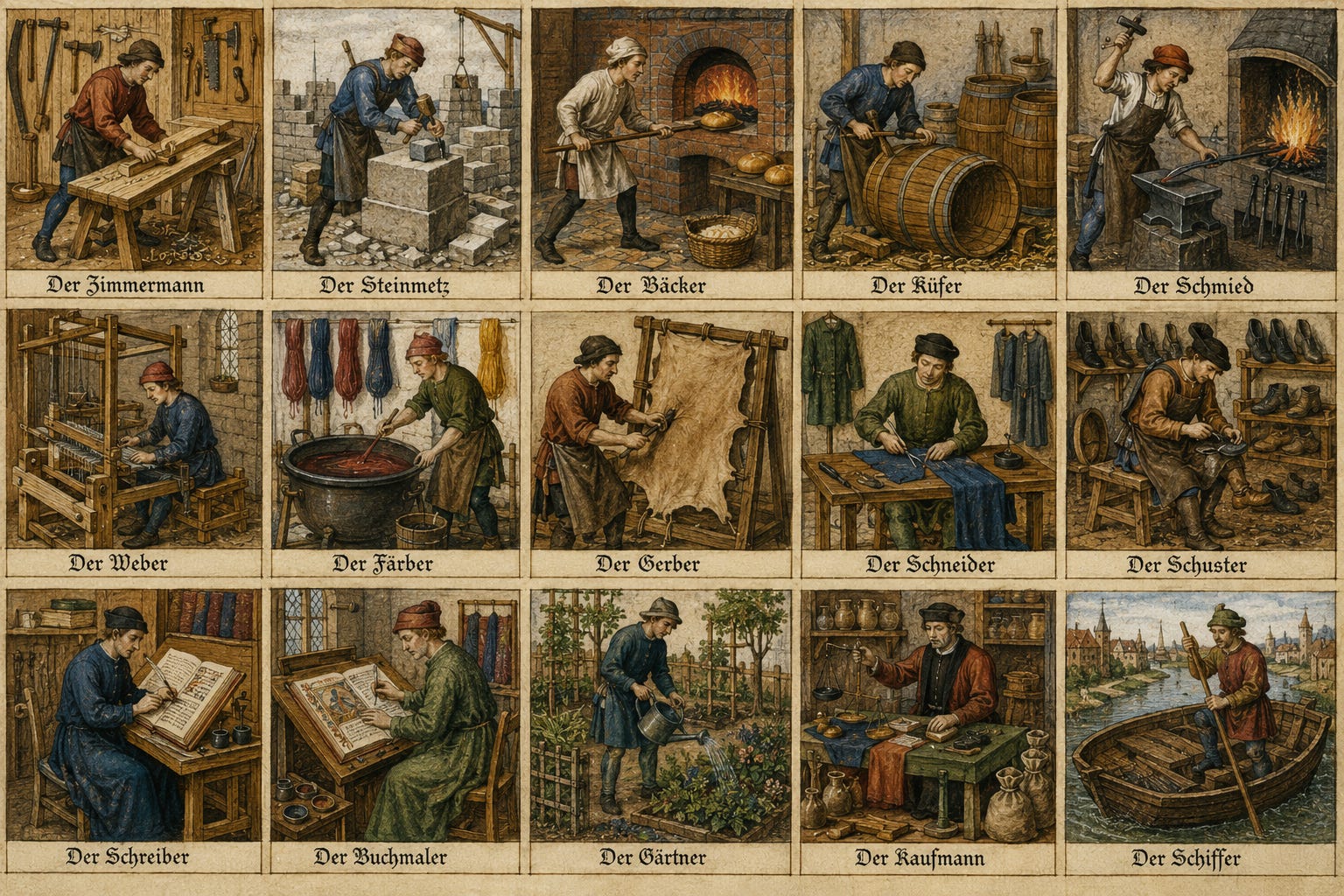
Guilds and the Constitutional Life of Towns
The word guild has dwindled in the modern ear to something quaint: an occupational association, an early trade union, a picturesque survival in the form of liveried companies and ceremonial processions, worthy of a museum case but long superseded by the corporation, the university and the state. Historically it was something far more substantial. For much of European life the guild was one of the principal constitutional institutions through which towns governed themselves, and to recover its character one must first set aside the modern assumption that citizenship is essentially a relationship between an individual and the state. That assumption is recent. For most of the past, public life was organised through a dense fabric of intermediary institutions standing between the household and the municipality, between private life and political authority, and the guild was among the most important of them.
A guild was certainly a community of practice. It gathered those engaged in a common craft, preserved its techniques, maintained its standards and transmitted its knowledge from one generation to the next through the long apprenticeship by which a novice became, in time, a master. Yet it was never only that. It regulated quality before any national inspectorate existed, judging who was fit to practise and answering for the reputation of the whole; it was a body of mutual obligation, drawing on common funds to support members in sickness and age, burying their dead and keeping their feasts; and it reached well beyond the workshop into the fabric of civic life, commissioning chapels and public buildings, endowing schools, maintaining bridges, sponsoring the paintings and music and stained glass whose beauty still defines the cities that hold them. To become a master was therefore to take on responsibility as much as skill, the duty to supervise the young and to uphold a standard one had not invented and would not outlive. The guild educated character as much as competence, because mastery and responsibility were one thing.
John Ruskin grasped what industrial society had broken when he founded his Guild of St George, which was not an attempt to costume the medieval past but to recover the moral relation between work, beauty and responsibility that the factory had severed. The Guild Socialists who came after him, A. R. Orage and G. D. H. Cole among them, extended the constitutional insight, arguing that citizenship had thinned into an abstract bond between the isolated individual and a distant state, where a healthy society requires intermediary institutions in which people learn responsibility by carrying real work. Recent scholarship has confirmed the older pattern: the historian Maarten Prak has shown that many medieval and early-modern towns functioned less as central bureaucracies than as living ecologies of guilds, confraternities, charitable foundations and neighbourhood associations, through which people belonged to the place at all. Citizenship ran outward in widening circles — from the household, through the guild, to the municipality — and responsibility was something accumulated through participation rather than conferred automatically on reaching a particular age.
The significance of the guild, then, is not that it belongs to the Middle Ages but that it embodied a principle our own arrangements have lost: that people learn citizenship most deeply by participating in institutions which unite knowledge, work, responsibility, beauty and mutual obligation within the shared life of a place. The guild educated because it entrusted, governed because it gathered, and endured because each generation initiated the next into responsibilities that could not be inherited merely by reaching a birthday. The question this raises is not whether the medieval guild should be revived, which is neither possible nor desirable, but whether a modern society requires institutions capable of performing analogous work — and, if it does, and if no such institution any longer exists, whether one might be built.
Reconstructing the Missing Institution
Every age inherits institutions it did not build, and most are so familiar that they have become invisible. We send children to school because that is what children do; we borrow from libraries and visit museums and enrol the young in sports clubs and scout troops and think little of the remarkable inheritance that makes such things possible, the accumulated experiment of centuries in how a society educates, remembers and organises itself. The temptation, in proposing anything new, is to begin by faulting what already exists, and the temptation should be refused. Schools perform an indispensable function. Libraries democratise knowledge, museums preserve memory, scouts cultivate resilience and service, sports clubs teach discipline and teamwork, and a great fabric of voluntary associations enriches civic life in ways made invisible by their very familiarity. The question worth asking is not what these institutions have failed to do, but what none of them was ever designed to do.
Each has a constitutional purpose, and each succeeds because that purpose is relatively clear. A museum preserves and interprets; a library curates and circulates; a school instructs; a sports club develops physical excellence through ordered competition. Taken together, however, they leave a curious absence, which becomes visible only when one asks where, across the whole of a childhood, a child learns to inherit a place — not merely to know its history or admire its architecture, but to care for it, maintain it, celebrate it and become answerable for its future. The absence is hard to notice because we have grown used to parcelling these things into separate domains: heritage to museums, knowledge to schools, volunteering to charities, practical skill to colleges, family life to the private sphere, and civic participation to an adulthood that arrives without apprenticeship. No institution gathers them into a single, lifelong pathway.
The fragmentation has become especially plain in the provision made for school holidays, which present families with a genuine difficulty, since parents continue to work while schools close. Communities answer, understandably and often imaginatively, with clubs and camps that keep children safe, occupied and stimulated through the intervening weeks, and these answer a real need. Yet they rest on a particular and limiting assumption: that the child is the participant, the parent the customer, the provider the deliverer of an experience, and the relationship concluded at the moment of collection. There is nothing wrong with the arrangement, but it is transactional to its root, and it takes the isolated child as the unit of everything it does. Suppose one began elsewhere. Suppose the family, rather than the individual child, were treated as the fundamental educational unit — the household that was, before professional provision arrived, the first school of citizenship, never sufficient alone but never peripheral either.
The professionalisation of civic life has raised standards immensely and exacted a corresponding price. As more of a community’s work has migrated to specialists — professional teachers and carers, professional curators and event organisers and conservators — ordinary people have gradually ceased to encounter that work as part of their own lives. Competence concentrates; participation declines; and children grow up surrounded by institutions maintained entirely by other people, visiting heritage rather than inheriting it, attending festivals rather than making them, consuming a hospitality they are never asked to offer. The result is less a civic decline than a civic distance, and the cure for distance is not instruction but contribution, for a place becomes one’s own through the labour one gives it, and responsibility, freely taken, alters both perception and affection. This points toward an institution of a different kind: not another school, nor another museum, nor another activity centre, but one whose explicit purpose is to induct children and families into the shared stewardship of a place through participation that deepens, year by year, from watching into responsibility. Such an institution would make civic life itself the curriculum, and history, craft, music, ecology, commerce and storytelling would enter not as separate subjects but as ways of taking part in the ordinary work by which a community sustains itself. It would resemble neither a classroom nor a club. It would resemble a guild.
The final essay sets out the institution itself in full — the Heritage Guild Club, its two foundations, its six pathway guilds, its festivals and its philosophy of progression — and follows the child from the doorway of the holiday club to adult stewardship of the place that formed them.