
The Missing Institution (I)
Part One: Fear, Interest and the Age Cohort

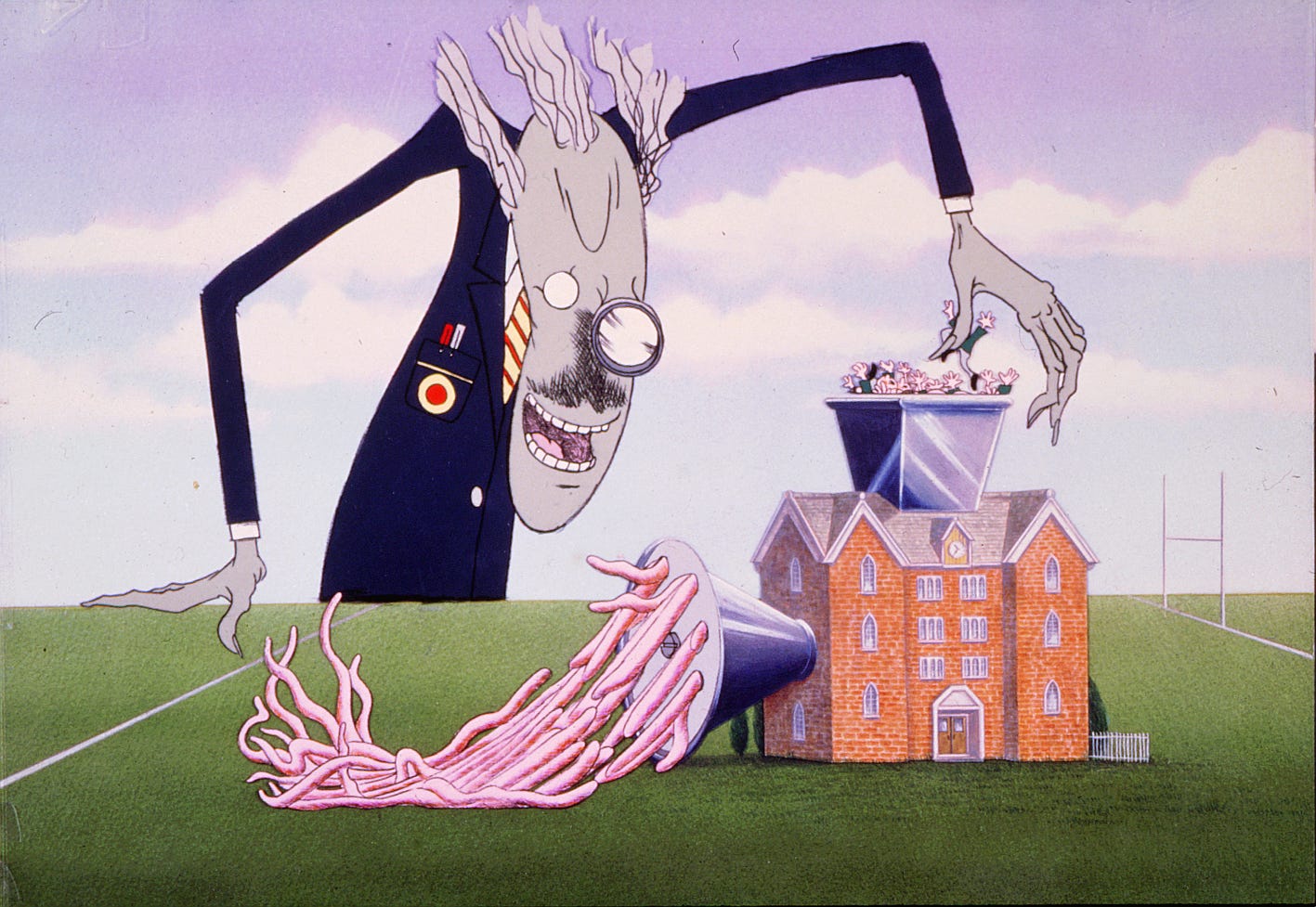
This is the first of three essays setting out an argument for a new civic institution for children and families — and the institution itself, the Heritage Guild Club, described in full.
“I think the big mistake in schools is trying to teach children anything, and by using fear as the basic motivation. Fear of getting failing grades, fear of not staying with your class, etc. Interest can produce learning on a scale compared to fear as a nuclear explosion to a firecracker.”
— Stanley Kubrick
Fear, Interest and the Age Cohort
The film director, Stanley Kubrick - a fellow American expat in Britain - held that the fundamental error of schooling was to teach children by fear — fear of the failing grade, fear of falling behind the class — and that interest, set against it as a motive, outproduces fear the way a nuclear explosion outscales a firecracker. The remark is usually taken as a complaint about teachers, or about the dreariness of the curriculum, the kind of thing a man of artistic temperament might be expected to say about institutions he found dull. It is better understood as a remark about structure. The fear he describes is not the work of unkind adults who might be persuaded to relax, nor a regrettable by-product of an otherwise sound arrangement. It is manufactured by the way the institution is built, and at the centre of that build sits an assumption so familiar that it has become invisible: that children should be sorted into groups by the year of their birth and advanced through their formation in lockstep.
Grouping by age is among the most arbitrary principles of organisation we possess, and we would recognise its arbitrariness at once if we applied it to anything else. To sort children by sex, or by race, or by the month of their birth, and to run each group along a single track at a single pace, would strike us as a relic of an unenlightened time. Sorting them by year strikes us as nature itself. We speak of Year Four or Year Nine as though these named stages of human development rather than administrative categories, and entire systems of buildings, timetables, teacher training and professional identity have been constructed upon them until they have disappeared from view. They are nothing of the kind. They are a recent invention, and the historian Philippe Ariès showed long ago that childhood itself, conceived as a sequence of sharply demarcated educational stages, was assembled over centuries rather than handed down by biology. The medieval world had organised learning less around specialised institutions than around households, workshops, parishes and neighbourhoods, where skills were acquired because someone nearby already possessed them and responsibility accumulated because responsibility was visible, and where children learned in the constant company of people both older and younger than themselves.
What replaced that arrangement owed more to industry than to pedagogy. Industrial society needed institutions capable of coordinating large populations with great regularity, and the factory supplied the template: workers arriving together, beginning together, pausing and finishing together at the discipline of the clock. The school took the same form, with its bells and its timetables, its annual promotion and its synchronised classes, and the achievement was genuine, for it brought a kind of order and universality that earlier provision had never managed. Yet every institutional achievement carries an institutional consequence, and the consequence of synchronised progression is that comparison becomes unavoidable. The question the institution asks of a child changes, quietly and decisively, from whether this child has become capable of the work to whether this child has kept step with the cohort. One question looks toward mastery; the other toward sequence. And because everyone moves together, everyone arrives at the same gate at the same moment, so that the gate at sixteen is made to bear a weight that no single season of a young life should carry.
Fear enters precisely here. Interest develops according to the peculiar rhythm of persons, attaching itself to different subjects in different children, deepening at irregular speeds, arriving sometimes years after a curriculum expected it. It cannot be administered, because it refuses to keep to a calendar. Fear, by contrast, administers itself: place people on a ladder, fix the order, require them to advance together and attach consequences to falling behind, and apprehension follows without any teacher having to intend it. Kubrick’s observation therefore returns with unexpected force, for the fear he named is not the residue of harsh teaching but the native product of an architecture of synchronised progression. To recognise this is not to condemn schools, nor those who labour within them, who compensate heroically for a constitutional limitation they did not design. It is to ask whether schools have gradually been required to perform tasks that no single institution, built on this principle, could reasonably bear — and whether the things most worth learning are precisely the things this principle cannot teach.
Learning, Work and Judgement
If the first question concerns how children are grouped, the second concerns what an education is finally for. Modern societies answer without much hesitation: education exists to transmit knowledge, which schools impart, universities extend, examinations certify and qualifications record. There is real truth in this, for every civilisation depends on the careful handing-on of languages, sciences, histories and discoveries that no generation could hope to rediscover for itself, and knowledge is indispensable. Yet knowledge alone has never been sufficient. A physician may know anatomy and still lack the judgement that reads a particular patient; a carpenter may understand geometry and be unable to raise a roof; a citizen may recite the constitution and prove incapable of chairing a meeting, organising a response to a flood, or caring for a public building. Between knowing and doing lies a third capability that modern educational thought has strangely neglected, and it is the one that matters most.
Judgement is not the possession of further information. It is the capacity to know what this particular situation requires, to recognise when a general rule applies, when it must be bent, and when it should be set aside altogether. It cannot be reduced to technique, because technique presupposes circumstances regular enough for rules to govern them, and the circumstances of human life rarely oblige. Alfred North Whitehead saw the danger with great clarity a century ago when he warned against what he called inert ideas — ideas received into the mind, examined, remembered, perhaps admired, yet never brought into living relation with experience. Such ideas are not false; they are merely disconnected, and Whitehead thought them positively harmful, because they manufacture the appearance of education while leaving understanding untouched. A child may know every stage of photosynthesis and never cultivate a garden, may analyse a play and never stand before an audience, may earn excellent marks in citizenship while never having borne a scrap of civic responsibility. The knowledge is real. What is absent is the world to which the knowledge belongs.
This separation would have puzzled most earlier societies, where learning was rarely detached from work because work was the setting in which knowledge acquired meaning. Children did not master abstract principles in order to apply them in some deferred adult future; understanding accumulated through participation in the ordinary activities of farm and workshop and kitchen and market and church. Arithmetic came through measuring timber and weighing grain, literacy mattered because contracts and scripture and accounts required it, music belonged to worship and festival, and craft preserved its knowledge through the hands as much as through any book. This was not a contempt for theory but its proper order: theory grew from practice and returned to it, and one learned because there was something worth doing. Modern education has increasingly reversed the sequence, so that practical activity, where it survives, is constructed as the illustration of a concept the curriculum has already chosen — children build a bridge to demonstrate forces, grow a bean to show germination — and practice becomes the servant of explanation rather than its source. The distinction is subtle and decisive. In one order, work exists for the sake of learning; in the other, learning exists for the sake of work, and only the second produces judgement.
The difficulty has become unignorable with the arrival of artificial intelligence, though the machine did not create it. For more than two centuries industrial society has excelled at decomposing complex activity into specifiable procedure, and where a process can be specified clearly enough it can be measured, optimised and at last mechanised; artificial intelligence has merely accelerated a tendency long under way and, in doing so, revealed its logic with unusual clarity. It exposes the difference between procedure and judgement. Procedures are increasingly reproducible, whether they are carried out in a warehouse or an office, and the more thoroughly a kind of work has been reduced to transferable technique the more readily it is now mimicked. Judgement remains stubbornly human. A machine may draft a contract and cannot answer for justice, may identify a disease and cannot sit with a frightened patient, may generate a hundred designs and cannot decide what kind of square a town should build. Knowledge has become abundant; judgement has become scarce. If routine knowledge is now easy to retrieve and to automate, then the distinctive task of an education can no longer be the accumulation of information, and must increasingly become the cultivation of the capacities that arise only through situated participation — discernment, trustworthiness, stewardship, cooperation, responsibility, practical wisdom. None of these can be acquired alone. They require communities organised around work that genuinely matters, in which one learns hospitality by welcoming, stewardship by caring for what depends on one’s care, and responsibility by being made responsible. There is no substitute, and the modern age cohort, which assembles children of identical experience and removes the older hand and the younger charge alike, interrupts the very traffic through which such capacities have always passed. If education is finally the formation of judgement and not the accumulation of information alone, then schools require companions — not replacements, companions — institutions in which knowledge returns to work and the generations once more learn alongside one another. History offers precisely such an institution, and its name has been so diminished that we have forgotten what it was.
Part Two continues the argument: what an education is finally for, and the institution history once built to answer it.